
Focus wins the PwC Innovation Award 2026 for its work on OpenNerve

November 6, 2026
We’re proud to have received the PwC Uruguay Innovation Award 2026 for our work on OpenNerve, an open-source implantable neurostimulation platform developed together with Medipace Inc.
About the PwC Innovation Award 2026
Created in 2020 by PwC Uruguay, part of the global PwC network, the Innovation Award recognizes companies that create value, improve processes, and promote sustainable practices. The jury evaluates each project on scalability, profitability, sustainability, and innovation. The award is backed by ANII, Uruguay’s National Agency for Research and Innovation.
This seventh edition had two categories, general and startup. Sixty-five companies took part, with 49 initiatives from 19 industries, and Focus won the general category. This is also our second year in a row among the recognized projects, after a special mention last year for our work on Glucotrack.
As our CEO Javier Schandy told Búsqueda, “For me, innovating means being able to adapt while the ground is shifting.” For us, the award recognizes that world-class medical technology can be built from Uruguay, and it strengthens our position with the international clients we work with every day.

About OpenNerve
For researchers and startups exploring new neurostimulation therapies, building an implantable device from scratch can take years and require significant investment. OpenNerve is helping change that.
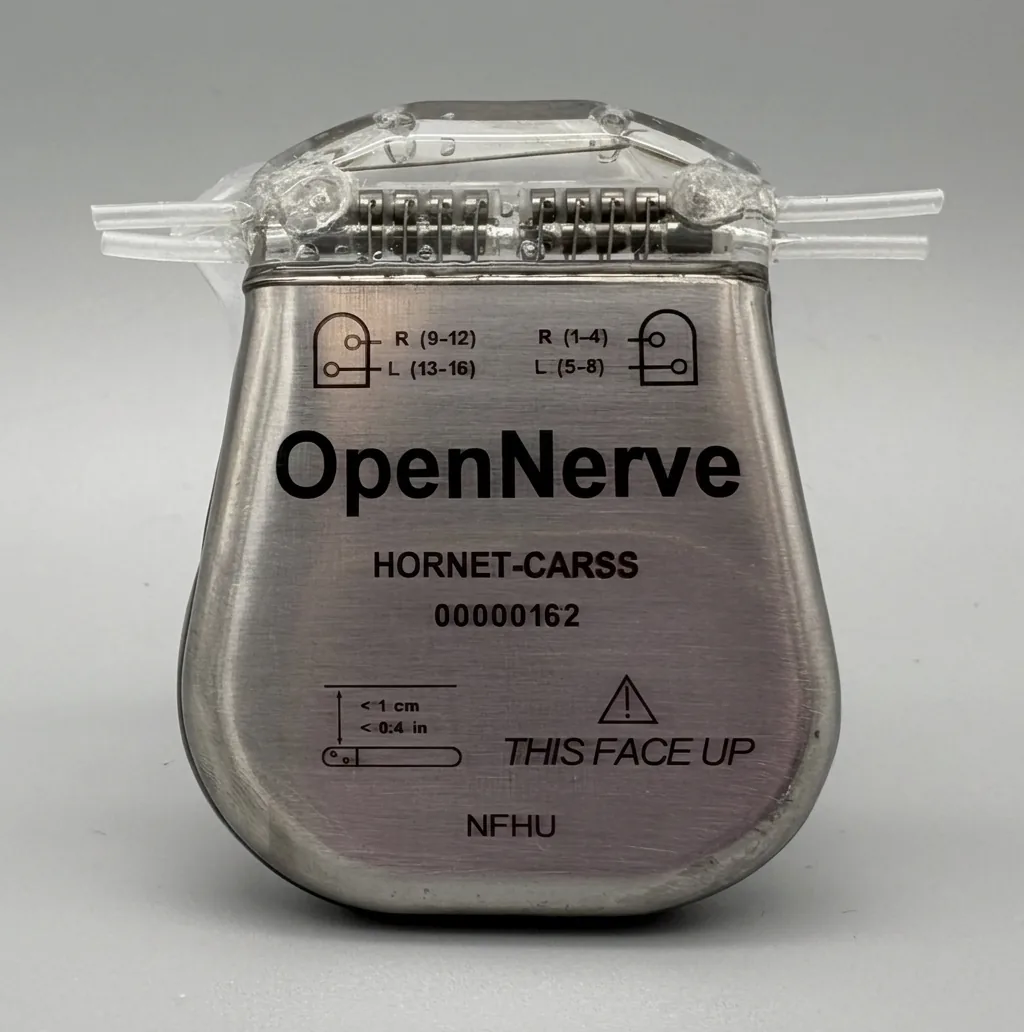
OpenNerve is led by the University of Southern California and funded by the US National Institutes of Health through the SPARC HORNET program. It offers an implantable pulse generator, stimulation and recording leads, sensors, a wireless charger, and control software, all released as open source under a license that allows research and commercial use. Researchers can build on the platform and adapt it to their needs instead of starting from a blank page. That leaves teams more time and money for the research itself and for testing new therapies.
Our work with OpenNerve
OpenNerve is the result of close collaboration between partners. We designed the electronics for the implant and for the wireless charger that recharges it through the skin, taking the work from architecture to a working prototype. Resonetics (formerly Med-Ally) developed the implant’s enclosure and leads and brought medical-grade manufacturing to the project, working alongside Medipace and the University of Southern California.
The device uses an STM32U5 microcontroller for stimulation, sensing, and control, and a Nordic nRF52 for low-power Bluetooth communication. You can read the full technical story in our OpenNerve case study.
The platform is already in use outside the lab where it started. We developed an adaptation of OpenNerve that researchers at the Mayo Clinic are using to evaluate new neuromodulation therapies, and institutions such as the University of Connecticut have shown interest in the open-source platform.
This recognition reinforces our ambition to keep innovating with purpose, taking on complex engineering challenges and turning ambitious ideas into technologies that make a difference.
Let’s connect
If you’re working on an implantable device or a complex medical technology project, let’s talk.
Stay focused on what’s next
Stories, ideas, and insights from the world of technology, product development, and innovation.




© Copyright 2026 Focus. All Rights Reserved.