Agile Under IEC 62304: How We Iterate Within Design Controls

November 27, 2026
Say "medical device software" and many engineers picture a waterfall. Requirements get frozen first, code comes later, and iteration dies somewhere in between.
That picture is wrong. IEC 62304, the international standard for medical device software, does not prescribe a lifecycle model. The stage gates come from design controls: the ISO 13485 requirement to plan, review, and verify development in defined stages.
At Focus, we run Agile sprints inside those gates. This article covers the two phases where most of that work happens: design and implementation. It also explains why iterating with the client produces a device that matches their real needs, with the right risk controls from the start.
IEC 62304 vs. ISO 13485: Where the Gates Come From
Two standards are central to how we develop medical device firmware: ISO 13485 and IEC 62304. Our quality management system (QMS) puts them into practice.
- ISO 13485 requires development in planned stages, with design reviews, verification, and transfer. This is where the gates come from.
- IEC 62304 defines the software work itself: requirements, architecture, implementation, verification, and release. It scales that work by safety class, from A (no injury possible) to C (death or serious injury possible). It deliberately leaves the lifecycle model open.
Both standards take a risk-based approach: the rigor required grows with the harm a failure could cause. IEC 62304's safety classes are the clearest example.
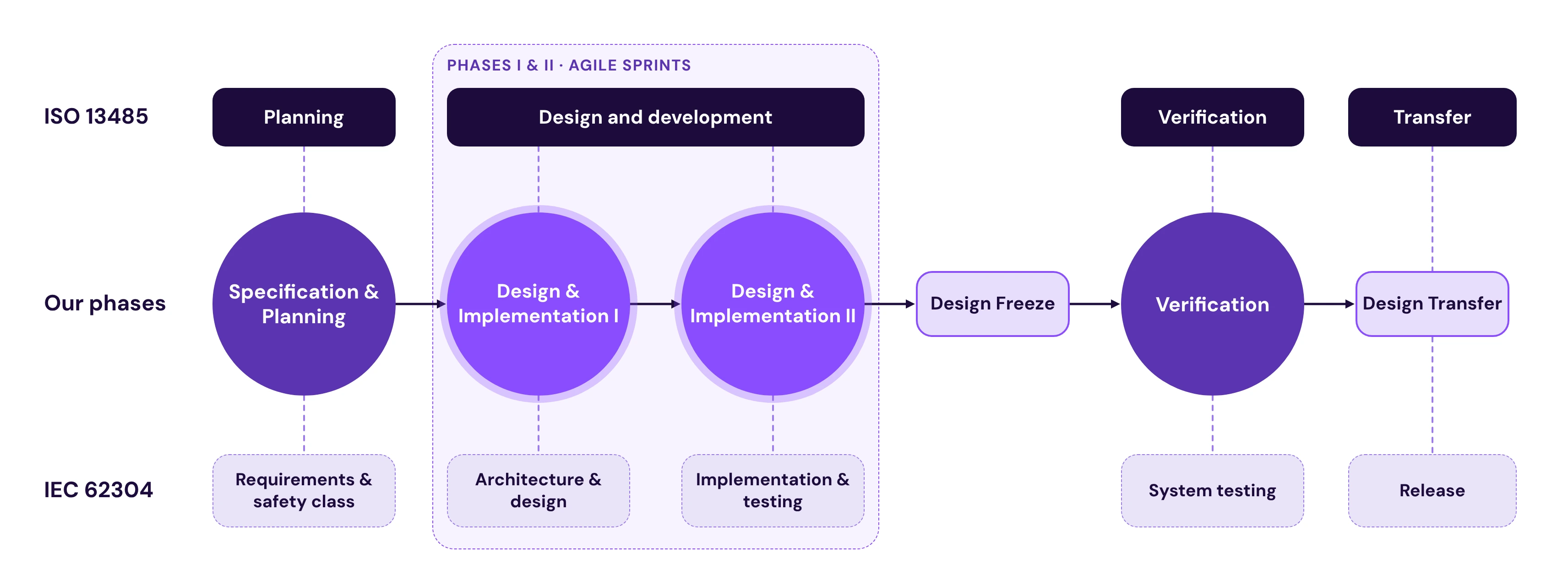
Our QMS maps the two onto these phases. Two milestones stand out: design freeze locks the design baseline, and design transfer hands verified software to the client.
- Specification and planning: software requirements are identified, the safety class is assigned, architecture is planned, and initial risk analysis is done.
- Design and implementation, Phase I: architecture and detailed design where the class requires them, preliminary implementation, verification planning, and further risk analysis.
- Design and implementation, Phase II: implementation is completed, with unit and integration testing where the class requires it. Tools are validated, verification protocols are written and run informally, and design documents are finalized for freeze.
- Verification: verification protocols are executed formally, every requirement is traced to its result, and the software is transferred to the client.
After transfer, maintenance and change control keep the released software under the same discipline.
Design and implementation, our Phases I and II, sit between planning and freeze. Each work item must pass through them in order. How we organize the work inside them is up to us. AAMI's TIR45 guidance on Agile practices takes the same position for the industry.
Requirements That Evolve Until Freeze
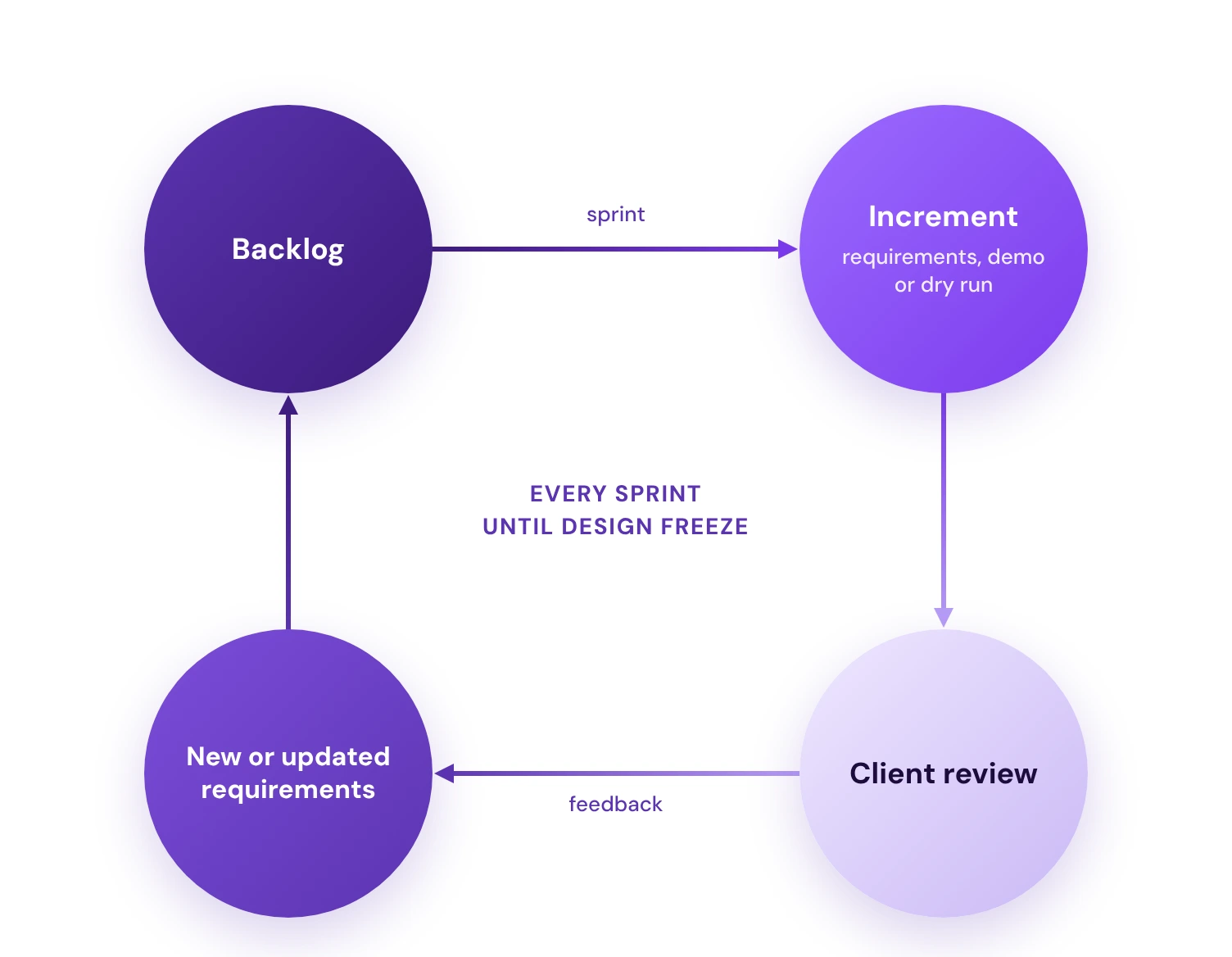
During Phases I and II, our backlog fills from two sources.
Planned work implements requirements already in the draft Software Requirements Specification (SRS). We know these at the start of a phase and size them like any other ticket.
Emergent work appears along the way. It comes from client conversations and technical discussions: a clarified expectation, a requested change, or an open design question. It also comes from needs that implementation reveals.
Not all emergent work changes the requirements, but when it does, the ticket starts one step earlier: we draft and review that requirement before any design or code. This stays affordable because the SRS remains a working document until freeze. Adding a requirement in Phase II costs one ticket. After freeze, it needs a formal change request.
Each sprint ends with something the client can react to: requirements, a demo, or a dry-run result. This loop drives most emergent work, and it is where Agile pays off most.
Writing a verifiable requirement forces precise questions. What tolerance? Under which conditions? What happens on failure? Sometimes the question is how to verify at all. If a quantity can't be measured directly, we agree the verification approach with the client first. Settling that early is far cheaper than finding out at integration.
Take a control state machine we built from a client's reference design. At first, the reference was our only specification, so implementation questions piled up faster than answers. Together with the client, we turned each state machine behavior into an explicit, testable requirement. From there, implementation became iterative: we built, tested against those requirements, and refined both as we learned. When the client later asked to change one of those behaviors, every requirement already traced to its tests. We could show the full impact before agreeing.
The result is better performance. The device matches the client's actual specification, not our interpretation of it.
It matters for safety too. Requirements carry risk control measures, so a misread requirement can become a hazard. Catching it during development beats catching it in verification, or worse, once the device is on the market.
Every Ticket Is a Small V-Model
Our development model is a V. Requirements and design run down one side, and verification comes back up the other. We apply the same shape to every ticket.
A ticket is done only when it has passed through five steps:
- Requirement: drafted and reviewed, if the ticket introduces a new one.
- Design: how the change fits into the existing software.
- Implementation: the code, reviewed and merged.
- Test case: written and traced to the requirement it verifies.
- Informal run: the test case executed on the current build.
The informal run matters most. Our process already calls for preliminary runs of verification protocols before freeze, and tying them to each ticket makes that continuous instead of a separate phase.
Problems surface while the change is small and the code is fresh, not weeks later in a full-device dry run. By then, most test cases have already passed once, so the full run becomes a confirmation rather than a discovery.
This only works if running tests is streamlined, which is where automation comes in. Where the project allows, our CI/CD pipelines run unit, integration, and verification tests on key merges and scheduled builds, and on some projects, hardware-in-the-loop setups let those tests exercise the firmware on real target hardware. Neither standard requires this level of automation; we keep extending it across our projects because it pays off.
Why Freeze Changes the Economics
Design freeze locks the design baseline. It requires a design review approved by both the client and our project lead.
After freeze, every change goes through formal change control, as required by ISO 13485 clause 7.3.9 and IEC 62304 clause 8.2. That means an impact assessment, quality approval, client notification, and documented verification, which is the right process for a locked design, even if deliberately slower. The impact assessment covers how the change affects functionality, performance, safety, regulatory requirements, and existing risk controls.
A requirement that costs one ticket in Phase II costs a full change request after freeze. That is why we push requirement definition into Phases I and II. The Agile loop exists to find surprises while they are still cheap.
The evidence shows up later. On our projects, most post-freeze change requests address anomalies found during verification, not changes in scope.
Agile and the Gates Work Together
IEC 62304 does not force a waterfall. This approach works because Agile and design controls solve different problems. Agile helps us discover what the device should do, while design controls prove that it does what was agreed. Trouble starts when one does the other's job: freezing requirements too early, or iterating once the evidence must hold still.
What connects the two is the documentation itself. A verifiable requirement turns a conversation into a decision, and a traced test case shows exactly what any change touches. That traceability is what lets us iterate quickly without losing track of what we built. Done this way, compliance is not overhead that Agile has to work around. It is what makes moving fast possible.
Get in touch
Planning medical device firmware and want to see how this would work on your project? Get in touch with our team.
Stay focused on what’s next
Stories, ideas, and insights from the world of technology, product development, and innovation.



Contact
Let’s Talk!© Copyright 2026 Focus. All Rights Reserved.