
BackAware
New Sensing Architecture for BackAware Belt
A wearable posture tracker rebuilt around inertial sensing fused with its original strain gauge, fully compatible with the production app.
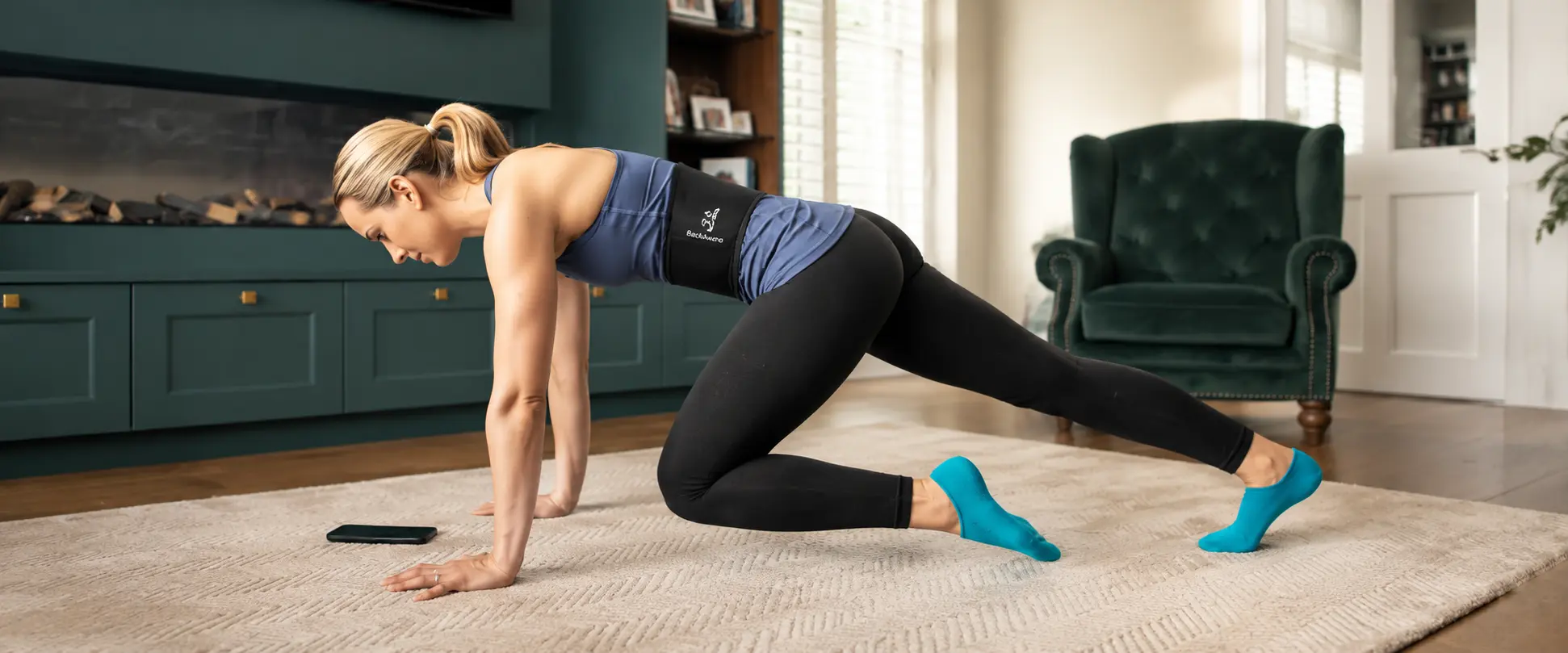
BackAware Belt is an Irish technology company developing wearable technology that gives people real-time feedback on their lower-back position. The belt uses sensors to track how the back moves, providing haptic feedback when posture or form moves outside a defined range, while a companion mobile app visualizes movement on screen and provides guided exercise content. As the product evolved, BackAware came to Focus to improve the accuracy and consistency of its sensing system, helping turn movement data into more reliable, actionable feedback for users. The first-generation belt measured back position using a single flex sensor, which limited the precision and usefulness of its readings. The sensor could drift from its expected offset, had a deadband around its resting position, and most importantly could not determine the direction of movement. To the firmware, flexion and extension could produce the same signal.
BackAware needed a more capable sensing architecture, but replacing the sensor was only part of the challenge. The new approach had to remain compatible with the existing mobile app, fit within the belt’s power constraints, and be validated before BackAware committed to new hardware.
What We Built
We first characterized BackAware’s existing technology. Our team bench-tested the original flex sensor, mapping its resistance across a 0–90° range and measuring how sustained flexion affected its readings after returning to rest. This established a documented baseline and the transfer curve needed to maintain compatibility with the existing app.
We then built a proof of concept around a different sensing architecture: an array of inertial measurement units (IMUs) working alongside the original strain gauge, with the signals combined through a sensor-fusion filter. The PoC ran on an ESP32, with raw data streamed to a PC so we could validate the system against real movement.
Finally, we mapped the new measurements to the value range expected by the app and reverse-engineered the belt’s Bluetooth protocol, allowing the prototype to communicate with the production mobile app without changes on the app side. The result was a working proof of concept that demonstrated the new sensing architecture in a real product environment, giving BackAware the evidence needed to move toward a new hardware design with greater confidence.
.webp)
.webp)
.webp)
Impact
In under five weeks, BackAware went from an open technical question to a working proof of concept and a clear path to a new hardware design. The fused sensing method demonstrated that it could estimate posture and distinguish bend direction, something the original flex sensor could not do. It was also validated while driving BackAware’s production mobile app, with no changes required on the app side. The PoC delivered every item in scope, plus an additional capability that had initially been ruled out. It also provided the foundation for the next phase: a costed hardware and firmware plan covering the added sensor board, changes to the existing hardware, haptic motor selection and vibration testing, and prototype manufacturing. BackAware could move forward with a new sensing architecture knowing both what it would take to build and that the underlying approach worked. The belt now shipping uses two calibrated sensors to measure spine position and was named one of TIME’s Best Inventions of 2024.
Two-point inertial sensing
Resolved bend direction that the flex sensor alone could not detect
Zero app changes
The proof of concept ran against the production mobile app
Under five weeks
From project ramp-up to validated prototype and documented handover.

Proving a new sensing method before committing to new hardware.
Start building together!
Let’s Innovate Together!



© Copyright 2026 Focus. All Rights Reserved.